Regulatory & Technical Updates
When a Dam’s Hazard Classification Deserves a Second Look
September 14, 2025
In June 2025, the North Carolina Department of Environmental Quality (NCDEQ) released the state’s first statewide, site-specific Probable Maximum Precipitation (PMP) Study, along with a companion PMP Evaluation Tool to support the NCDEQ Dam Safety Program.
This marks the first time North Carolina has developed PMP values tailored specifically to its geography, climate, and storm history. The study provides a modern, science-based foundation for understanding extreme rainfall and storm risk, giving dam owners, engineers, and regulators access to more accurate, locally relevant data for dam safety evaluations, flood risk management, and storm preparedness planning.
RiskHydro was honored to serve on NCDEQ’s PMP Technical Advisory Committee, contributing to the development of this statewide effort to modernize rainfall estimation and strengthen North Carolina’s dam safety program.
The new PMP Study and Evaluation Tool replaces outdated guidance from the 1970s and provides a much higher level of accuracy and usability. Key improvements include:
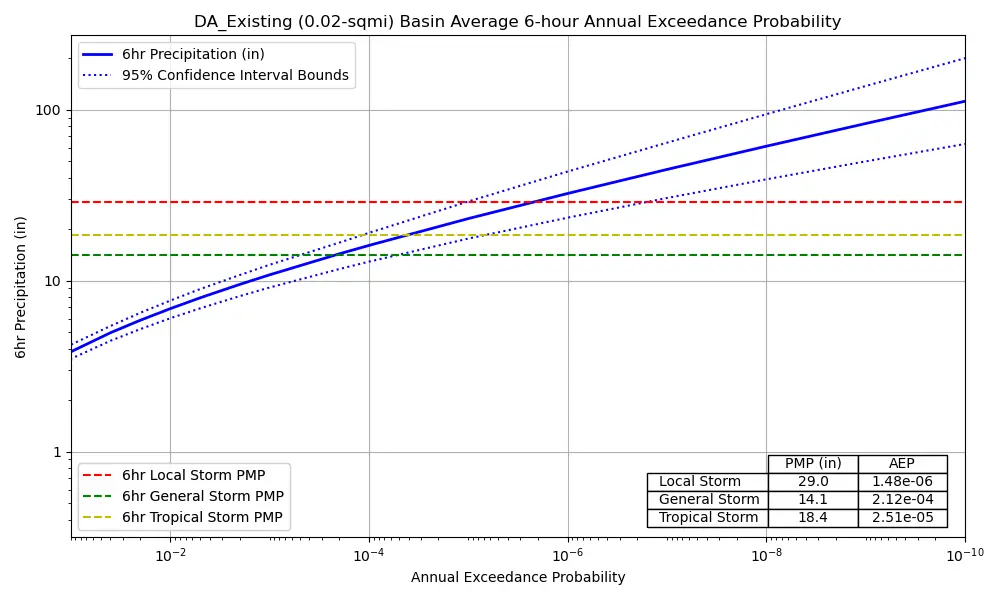
The full study and tool can be downloaded directly from the NCDEQ Dam Safety Program PMP Study and Evaluation Tool webpage. The site includes the PMP data files, evaluation tool, user guide, and training videos for public use.
The new PMP Tool changes how consultants and dam owners in North Carolina evaluate rainfall risk and plan for extreme events.
RiskHydro is already applying the new PMP data and methodology across ongoing dam safety and hydrologic studies throughout the state. Our team combines deep technical expertise with direct insight from our participation on the NCDEQ Technical Advisory Committee to help clients adapt efficiently and confidently. We help clients with:
North Carolina’s new PMP Tool represents a major advancement in how the state approaches extreme rainfall, dam safety, and storm preparedness. It reflects modern data, rigorous analysis, and collaboration among engineers, scientists, and regulators.
At RiskHydro, we remain committed to helping clients apply the new data with clarity, precision, and confidence to protect both infrastructure and communities across North Carolina.